Next up were Lokai. These guys from Austria droned away on a guitar at an extremely leisurely pace and tapped the cymbals very slowly, strongly reminding me of Radian, whose album, incidentally, I never managed to finish. Amusingly, the resemblance turned out to be far from coincidental: Radian’s founder actually plays in Lokai. My impressions of the performance were somewhat colorless. It seemed fine, but somehow not very engaging. I wouldn’t exactly call it boring, yet listening to it didn’t really grab me either. Admittedly, the guy with the suitcase-like effects unit improved matters: after he twiddled its knobs and pressed its buttons, the character of the sound changed dramatically, which made it more interesting.
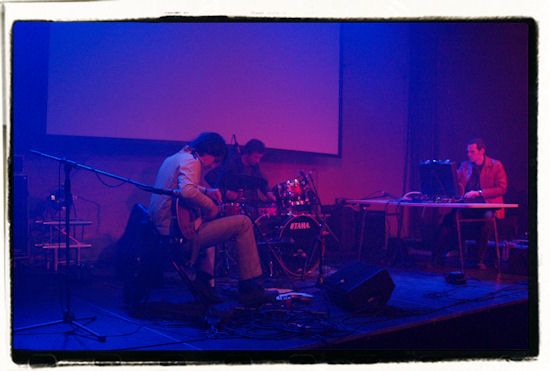
Lokai
By the way, my friend
the fake <label of your choice> left during Lokai’s performance for the electronic hall to wait for The Bug, whom I had recommended to him. The Bug appeared only 20 minutes later, and the fake emo (not even an emo, actually, but more of a hipster, as I recently learned) risked missing Colleen. But she was waiting for the equipment to become available, while we sat for half an hour admiring the empty stage. I even went to see The Bug, but found nothing there apart from the horrendous volume of the poor-quality sound and a rapping Black woman of the “Big Mama” variety. I won’t post the video—I don’t see the point.
Now about Colleen. For those who don’t know, she is a woman from France named Cécile Schott, and she makes beautiful, psychedelic music, albeit simple. The basic idea is this: acoustic instruments are used to record repeating passages, which are then layered over one another with delay and echo effects added. The result is a layered cake of lingering high-pitched sounds that immediately conjures up crystal palaces or something of that sort.
Cécile looks modest and peaceful, and plays various acoustic instruments in concert. First, the Viola Da Gamba, an ancestor of the modern cello dating back to the Renaissance. Then the flute and guitar, and she also jingled some bells. She recorded all of this on a simple sampler with a pedal, which she pressed with her foot (I think), and then played against the sounds from the sampler.
Colleen @@ Skaņu Mežs 2008 - Viola Da Gamba from Vladekk on Vimeo.
Overall, I liked it less than the album. The album has melodies, a carefully considered structure, and lots of different instruments playing simultaneously. Here, though, she played the flute, recorded the flute, then played along with the recording. On the other hand, it was very amusing to watch the audience members, who had previously been listening to terrifying noise and generally looked like alternative types, sitting there afraid to move lest they disrupt the “fragile magic of the acoustic space” with their noise. It’s in quotation marks because it’s a cliché, and whether there was any magic at all is open to question. After all, you can’t say that a miracle happens automatically just because you’re a fragile-looking woman playing the cello and overusing ancient psychedelic effects.
Colleen @@ Skaņu Mežs 2008 - Guitar from Vladekk on Vimeo.
Although, generally speaking, it was a good performance, especially the guitar part. But with me it’s like in “War and Peace”—man is a weak creature, and the state of his spirit depends on the conditions of the outside world and a random-number generator. What I mean is that I liked most of the sets. But sometimes I suddenly get fed up with everything and feel like leaving altogether. Then, all of a sudden, I like it again. And this can happen not only during different performances, but even over the course of a single one. I don’t deny that I’m an emo too.
Colleen @@ Skaņu Mežs 2008 (flute) from Vladekk on Vimeo.
After Colleen came the Icelandic Hildur Gudnadottir, playing the cello, accompanied by a bespectacled, close-shaven man—BJ Nielsen. The man floated in the smoke, which the organizers were pumping out far too enthusiastically, and could barely see his laptop, which amplified and transformed the drone produced by the cello. Not especially convincing, but you can listen and decide for yourself.
Hildur Gudnadottir & BJNilsen @@ Skaņu Mežs 2008 from Vladekk on Vimeo.
The last to perform was indie-folk diva Marissa Nadler. She was dressed entirely in red, like Zavoloka. There is something Greek about her appearance, and she also has three guitars and three microphones. Marissa was astonished beyond words to find herself performing at two in the morning and said it was a first for her, but she still came back for an encore. It must be said that during the festival’s final days, the audience called very few performers back for an encore, and even when they did, no one returned. Admittedly, it would have been strange for performers who play one continuous stream rather than separate compositions to come back for an encore, and they were the majority.
Marissa, though, plays songs—songs that sound cosmic, as does her voice. Marissa is a mezzo-soprano, meaning the second-lowest female voice in opera. Curiously, the famous pop singer Shakira is a contralto, meaning the lowest female voice in the classification. What interests me is this: why are their voices classified by operatic standards? To the ear, they really do have a certain “operatic” quality and power, but are there any formal criteria?
Incidentally, Shakira has an IQ of 140, writes the music and lyrics for all her songs herself, and speaks six languages.
But we aren’t talking about her right now. As for Marissa, all I can say is that although her music sounds majestic and expansive, it is alien and boring to me because, in practice, it is still a bard song, which I cannot stomach in any form. Music should be varied and original in its sound—and what could be more worn-out than an acoustic guitar? The one consolation is that the guitar is seasoned with an echo effect, while Marissa’s voice can rival a sophisticated instrument.
What can be said about the third day as a whole?
Zavoloka delighted me more than anyone else. Colleen was cool, but the album is better. As for the rest —the noise and the sound cranked sky-high grew tiresome long ago; you won’t surprise the audience with that. Musicians need to look for something new, avoid overdoing the “organic plasma flow,” and improve their equipment, because all the droning and clattering fades into one monotonous mush.